
Yes, ping pong is a sport. Under its official name, table tennis, it has its own international federation, a professional world tour, world championships dating back to 1926, and a permanent place at the Olympic Games since 1988. It’s also one of the most physically and mentally demanding racket sports at a high level.
So why do people still ask? Mostly because ping pong is also a hugely popular casual game, played in basements, offices and bars by people who never think of it as athletics. Below, we look at what makes something a sport, how table tennis measures up, and answer the most common related questions.
What Makes Something a Sport?
There’s no single official definition, but most definitions come down to a few key elements:
- Physical effort and skill: the outcome depends on the athlete’s body, not chance.
- Competition: there’s a winner and a loser under agreed conditions.
- Standardized rules: the game is played the same way everywhere.
- Organization: governing bodies run competitions and enforce the rules.
Table tennis meets every one of these criteria.
Why Table Tennis Is a Sport
It Has a Global Governing Body
The International Table Tennis Federation (ITTF) was founded in 1926 and today has more than 200 member associations, making it one of the largest sports federations in the world. The ITTF publishes the official rulebook, approves equipment, and runs world championships and the World Table Tennis (WTT) professional tour. Every country has its own national association too, such as USA Table Tennis in the United States.
It’s an Olympic and Paralympic Sport
Table tennis joined the Olympic program at the 1988 Seoul Games and has been part of every Summer Olympics since. Today, Olympic table tennis includes five events: men’s and women’s singles, men’s and women’s team events, and mixed doubles, which was added in Tokyo.
The sport has an even longer history at the Paralympics: table tennis has been on the program since the very first Paralympic Games in Rome in 1960.
It Has Standardized Rules and Equipment
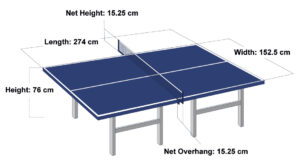
A match in Tokyo, Toronto or a neighborhood club follows the same rules: games to 11, two serves each, and strict serving requirements. The table, net, ball and paddle all have official specifications. For the details, see our guides to the official ping pong rules and ping pong table dimensions.
It’s Physically Demanding
Casual ping pong is gentle exercise, but competitive table tennis is intense. At elite level:
- Players react to shots in a fraction of a second, with smashes that can exceed 60 mph across a table only 9 feet long.
- The ball can spin so fast that a small change in paddle angle decides the point.
- Players constantly move in short, explosive bursts, side to side and in and out from the table, over matches that can last an hour.
It’s also a mental game. Reading spin, varying serves and adapting tactics mid-match are why table tennis is sometimes called “chess at 100 miles an hour.”
Even at a recreational level, table tennis gets your heart rate up. Learn more in our article on whether table tennis is good exercise.
Ping Pong vs. Table Tennis: Is There a Difference?
They are the same sport. “Table tennis” is the official name, used by the ITTF and national federations. “Ping-Pong” started as a brand name: the English company J. Jaques & Son trademarked it around 1901, and Parker Brothers later held the rights in the United States. Because the name was a trademark, the official associations adopted “table tennis” instead.
Today, the terms are used interchangeably. Some players use “ping pong” for casual basement games and “table tennis” for the competitive sport, but the rules are the same.
Is Ping Pong a Chinese Sport?
No, the game was invented in England in the late 19th century as an after-dinner parlor game for the upper classes. It spread to Central Europe and Asia in the early 1900s, and Hungary dominated the early world championships.
China took up the sport seriously in the 1950s. Rong Guotuan became China’s first world champion in 1959, and since then China has become the sport’s dominant power. Chinese players have won the vast majority of Olympic table tennis gold medals, including all five events at the Paris 2024 Games.
Table tennis even played a part in world history: in 1971, the U.S. table tennis team’s visit to China, known as “ping-pong diplomacy,” helped thaw relations between the two countries.
Is Ping Pong a Racket Sport?
Yes. Table tennis belongs to the racket sports family along with tennis, badminton, squash and pickleball. What makes it unique is the scale: the small table and light ball make spin and reaction speed even more important than in other racket sports.
Is Ping Pong a Sport FAQ
Is table tennis an Olympic sport?
Yes. Table tennis has been an Olympic sport since the 1988 Seoul Games, with singles, team and mixed doubles events.
Is ping pong the same as table tennis?
Yes. Table tennis is the official name of the sport, while “Ping-Pong” began as a trademarked brand name. The rules are identical.
When did ping pong become a sport?
Ping pong was invented as a parlor game in England in the 1880s and 1890s. It became an organized sport in the early 1900s, and the ITTF was founded in 1926, the same year as the first World Championships.
Is ping pong a professional sport?
Yes. Top players compete for prize money on the World Table Tennis (WTT) tour and in professional leagues in China, Japan, Germany and other countries.
Can anyone play ping pong?
Yes. Table tennis is one of the most accessible sports: it suits all ages and fitness levels, is easy on the joints, and can be played competitively by wheelchair users and players with other disabilities.
Facts in this article are based on information from the ITTF and the International Olympic Committee.