
An official ping pong ball is 40 mm (1.57 inches) in diameter and weighs 2.7 grams (about 0.095 ounces). It’s white or orange with a matte finish, and since 2014 it has been made of plastic rather than celluloid. Here’s everything you need to know about ping pong ball size, weight, materials and star ratings, plus how to choose the right balls.
Official Ping Pong Ball Specifications
| Specification | Official requirement |
|---|---|
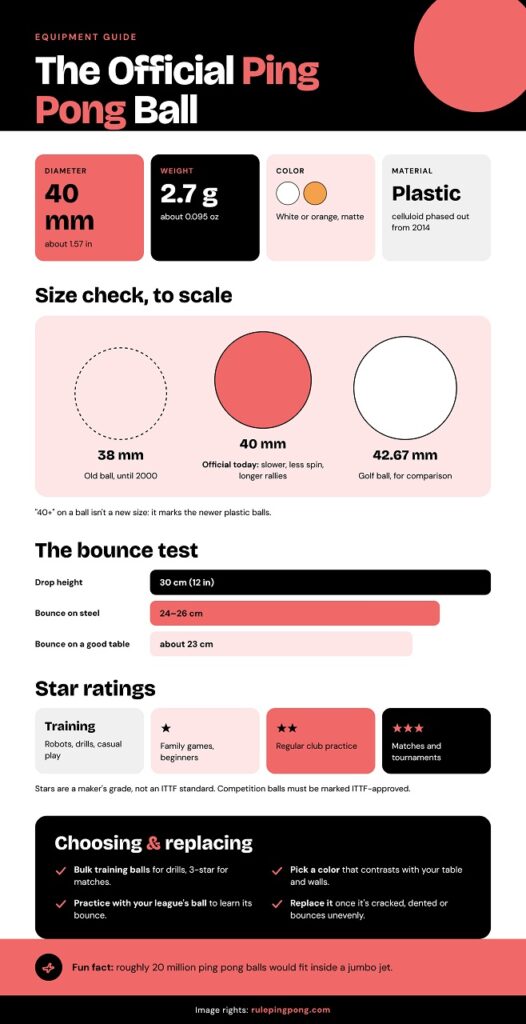
| Diameter | 40 mm (about 1.57 in) |
| Weight | 2.7 g (about 0.095 oz) |
| Shape | Spherical |
| Color | White or orange, matte |
| Material | Plastic (celluloid was phased out from 2014) |
These requirements come from ITTF Laws 2.3.1–2.3.3. The ITTF also tests balls for roundness, hardness and bounce before approving them for competition.
How Big Is a Ping Pong Ball?
A regulation ping pong ball is 40 mm across, which is about 1.57 inches. That’s a little smaller than a golf ball, which is at least 42.67 mm (1.68 inches) in diameter.
Many newer balls are marked “40+”. The plus sign doesn’t mean a different official size; it simply identifies the newer plastic balls, which play slightly differently from the old celluloid ones.
The Switch From 38 mm to 40 mm
Until 2000, official balls were 38 mm in diameter and weighed 2.5 g. After the Sydney Olympics, the ITTF switched to the larger 40 mm ball. The bigger ball has more air resistance, so it travels slightly slower and spins slightly less, which makes rallies longer and easier for spectators and TV viewers to follow. Read more about this and other rule changes in our history of table tennis.
How Much Does a Ping Pong Ball Weigh?
An official ball weighs 2.7 grams, a little over half the weight of a standard sheet of printer paper. That light weight is why the ball reacts so strongly to spin and why air resistance slows it down so quickly.
How High Does a Ping Pong Ball Bounce?
Under the ITTF standards, a regulation ball dropped from a height of about 30 cm (12 inches) onto a standard steel block must bounce back to roughly 24–26 cm (9.5–10 inches). On a table, the bounce is a little lower; a good table should return the ball to about 23 cm from the same drop. The bounce test is a quick way to check both your balls and your table.
What Are Ping Pong Balls Made Of?
For more than a century, ping pong balls were made of celluloid, an early plastic that bounced well but was highly flammable and increasingly hard to produce. In 2014, the ITTF switched to non-celluloid plastic balls for international competition.
Today’s balls are made from plastics such as ABS. They come in two main types:
- Seamed balls: made from two hemispheres joined at a seam, the traditional method.
- Seamless balls: formed as a single piece, which can give a more consistent bounce.
Compared to celluloid, plastic balls feel slightly harder and generally produce a bit less spin.
Ping Pong Ball Colors: White or Orange?
Official balls are either white or orange. Organizers choose the color that contrasts best with the table and surroundings: white works well with dark tables and backgrounds, while orange is often easier to see in brighter surroundings. Most modern competitions use white balls on blue tables. Some practice balls come in other colors, or in two colors, which makes it easier to see spin, but they aren’t legal in competition.
Ping Pong Ball Star Ratings Explained
Most balls are sold with a star rating from one to three. The star system isn’t an official ITTF standard; it’s a quality grading used by manufacturers:
| Rating | Quality | Best for |
|---|---|---|
| No stars / “training” | Basic, less consistent | Robots, multiball drills, casual play |
| 1 star | Recreational quality | Family games, beginners, practice |
| 2 stars | Better consistency | Regular club practice |
| 3 stars | Highest quality, most consistent | Matches, tournaments and serious practice |
For official competitions, the ball must be ITTF-approved, which is marked on the ball. Approved balls are typically sold as 3-star balls. For casual play, 1-star balls work fine; for regular practice, 3-star training balls offer a good balance of quality and price.
How to Choose Ping Pong Balls
- Match the ball to the purpose. Buy cheap training balls in bulk for robots and drills, and save 3-star balls for matches.
- Stick to 40 mm plastic balls unless you’re playing a specific old-style format.
- Pick a color that contrasts with your table and walls.
- Use the same type of ball you’ll compete with if you play in a league, so you’re used to how it bounces.
How Long Do Ping Pong Balls Last?
A quality ball can last for many sessions, but all balls eventually crack, especially when hit hard or stepped on. Replace a ball as soon as it’s cracked, dented or bounces unevenly, because a damaged ball plays unpredictably. Shallow dents in older celluloid balls could sometimes be popped out with hot water, but that rarely works on modern plastic balls and never fixes a crack.
Fun Fact: How Many Ping Pong Balls Fit in a 747?
It’s a famous job-interview puzzle. A ping pong ball has a volume of about 33.5 cubic centimeters, and randomly packed spheres fill roughly 64% of a space, so about 19,000 balls fit in one cubic meter. If you assume around 1,000 cubic meters of usable space inside a jumbo jet, the answer comes to roughly 20 million balls. The exact number depends on the model and on what you count as usable space, but interviewers care more about the reasoning than the number.
More Equipment Guides
For the rest of the official equipment specifications, see our guide to ping pong table dimensions, learn how to choose a ping pong paddle, and brush up on the official ping pong rules.
Ping Pong Ball Size and Weight FAQ
What size is a ping pong ball?
A regulation ping pong ball is 40 mm (about 1.57 inches) in diameter.
How much does a ping pong ball weigh?
An official ping pong ball weighs 2.7 grams, or about 0.095 ounces.
Are all ping pong balls the same size?
All official balls today are 40 mm. Older balls made before 2000 were 38 mm, and some novelty or practice balls come in other sizes.
What does 40+ mean on a ping pong ball?
“40+” marks the newer plastic balls introduced in 2014. They’re still the official 40 mm size but play slightly differently from the old celluloid balls.
What’s the difference between 1-star and 3-star ping pong balls?
Star ratings indicate quality. 3-star balls are the roundest and most consistent and are used for matches, while 1-star balls are cheaper recreational balls.
What are ping pong balls made of?
Modern ping pong balls are made of plastic such as ABS, as required by ITTF Law 2.3.3. Before 2014, they were made of celluloid.
Last reviewed: October 2026. Rule numbers refer to the Laws of Table Tennis (ITTF Statutes, 2026 edition).