
How you hold the paddle affects every shot you play. A good grip lets you switch smoothly between forehand and backhand, use your wrist for spin and keep your strokes consistent. A bad grip limits you no matter how much you practice. Here’s how to hold a ping pong paddle correctly, the main grip styles and the most common mistakes.
Quick Answer: The Shakehand Grip
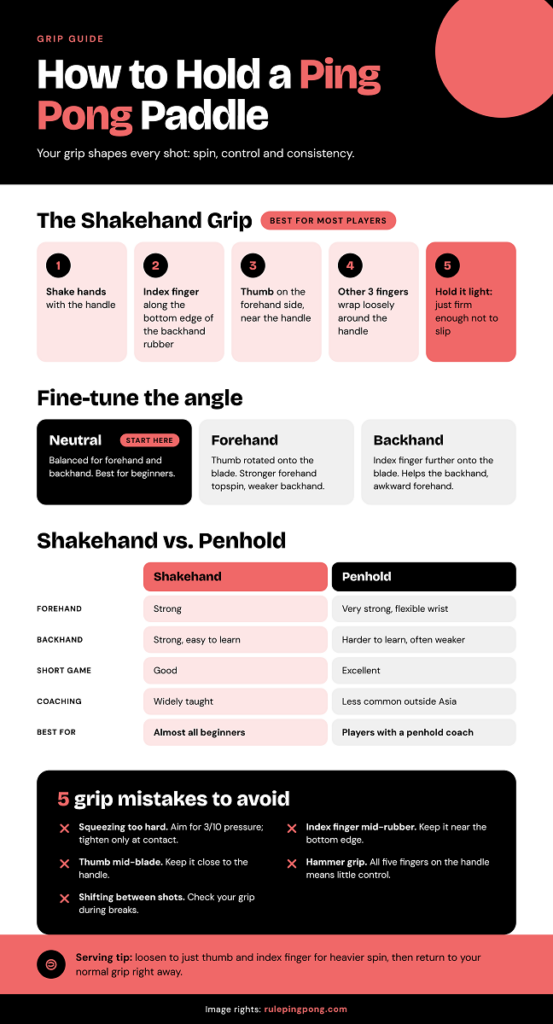
For most players, the best way to hold a ping pong paddle is the shakehand grip:
- Hold the paddle by the handle as if you were shaking someone’s hand.
- Rest your index finger along the bottom edge of the rubber on the backhand side.
- Rest your thumb on the forehand side, near where the handle meets the blade.
- Wrap your other three fingers loosely around the handle.
- Hold the paddle lightly, just firmly enough that it won’t slip.
It’s the grip used by most of the world’s top players and the one most coaches teach first, because it works equally well for forehands and backhands.
The Shakehand Grip in Detail
Finger Placement
When you look at the paddle from the edge, your thumb and index finger should form a “V” that points roughly along the edge of the blade. Your index finger lies flat along the backhand rubber near its bottom edge, not in the center of the rubber. Your thumb rests lightly on the forehand rubber, close to the handle, without pressing into the middle of the blade.
Neutral, Forehand and Backhand Grips
Small adjustments change the angle of the paddle:
- Neutral grip: the “V” is centered on the edge of the blade. Equally good for forehand and backhand. Best for beginners.
- Forehand grip: the paddle is rotated slightly so the thumb is more on the blade. It closes the forehand angle naturally and helps forehand topspin, at the cost of a weaker backhand.
- Backhand grip: the opposite rotation, with the index finger further onto the blade. It helps the backhand but makes the forehand awkward.
Start with a neutral grip. Many experienced players make tiny grip shifts during play, but that’s an advanced skill.
Shallow vs. Deep Grip
In a shallow shakehand grip, the hand sits lower on the handle, which frees the wrist for spin and touch. In a deep grip, the hand is pushed up against the blade, giving more stability and power but less wrist movement. Most players fall somewhere in between.
The Penhold Grip
In the penhold grip, you hold the paddle like a pen, with the handle pointing up between your thumb and index finger. Penhold is traditional in China, Japan and Korea, and some of the greatest players in history used it.
Chinese Penhold
The thumb and index finger wrap around the front of the handle, while the other three fingers curl and rest against the back of the blade. Modern Chinese penholders usually have rubber on both sides and play a reverse penhold backhand, turning the paddle to hit backhands with the back side.
Japanese/Korean Penhold
This style uses a paddle with a squarer blade and a cork block on the handle. The three back fingers are kept straighter and spread across the back of the blade. Traditionally these paddles have rubber on only one side, and players rely on fast footwork to play mostly forehands.
Should You Use Penhold?
Penhold can produce excellent short play and a powerful forehand, but the backhand is harder to learn, and fewer coaches outside Asia teach it. Unless you have a coach who plays penhold, start with shakehand.
Other Grips
- Seemiller grip: named after American champion Dan Seemiller, who popularized it in the 1970s. The index finger is wrapped around the edge of the blade and the same side of the paddle is used for forehand and backhand. It’s rare today.
Shakehand vs. Penhold: Pros and Cons
| Shakehand | Penhold | |
|---|---|---|
| Forehand | Strong | Very strong, flexible wrist |
| Backhand | Strong and easy to learn | Harder to learn; often weaker |
| Short game over the table | Good | Excellent |
| Switching forehand/backhand | Easy, apart from a “crossover point” near the elbow | Easy for balls near the body |
| Coaching available | Widely taught | Less common outside Asia |
| Best for | Almost all beginners | Players with a penhold coach or a strong preference |
Common Grip Mistakes
- Squeezing too hard. A tight grip locks your wrist and forearm and kills your touch. Think of holding the paddle at about 3 out of 10 in strength, and tighten only at contact on powerful shots.
- Index finger in the middle of the backhand rubber. It feels stable, but it blocks your backhand and restricts the wrist. Keep it near the bottom edge.
- Thumb pressing into the middle of the forehand side. It forces a backhand-style angle. Keep the thumb near the handle.
- Holding the paddle like a hammer. Wrapping all five fingers around the handle with no finger on the blade gives very little control.
- Constantly changing grips. Beginners often adjust their grip between shots without realizing it. Check your grip during breaks until it becomes automatic.
Should You Change Your Grip to Serve?
Many players loosen their grip for serves, often holding the paddle with just the thumb and index finger with the other fingers relaxed. This frees the wrist and helps create heavy spin. Just remember to return to your normal grip immediately after the serve. Make sure your serve is legal too; see our ping pong serve rules.
Choosing a Handle That Fits Your Grip
Shakehand players can choose between flared, straight and anatomic handles, while penhold players need a penhold-specific handle. If the handle feels too thick or too thin, your grip will suffer. Learn more in our guide on how to choose a ping pong paddle, and put your new grip to work with our table tennis tips.
How to Hold a Ping Pong Paddle: FAQ
What is the correct way to hold a ping pong paddle?
Most players use the shakehand grip: hold the handle like a handshake, with your index finger along the bottom of the backhand side, your thumb on the forehand side near the handle, and your other fingers wrapped loosely around the handle.
Is penhold or shakehand better?
Neither is objectively better; world champions have used both. Shakehand is easier to learn and more widely taught, so it’s the best choice for most beginners.
How tight should you hold a ping pong paddle?
Loosely. Hold it just firmly enough that it won’t slip, and tighten your grip only at the moment of contact on powerful shots.
Where should your index finger go on a ping pong paddle?
In the shakehand grip, your index finger rests along the bottom edge of the backhand rubber, near the handle, not in the middle of the blade.
Can you switch hands in ping pong?
Yes. The rules allow you to switch the paddle to your other hand, though it’s rarely useful. The hand holding the paddle is your “racket hand”; the other is your “free hand,” which must never touch the table during a rally.