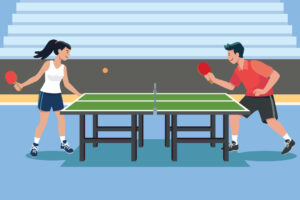

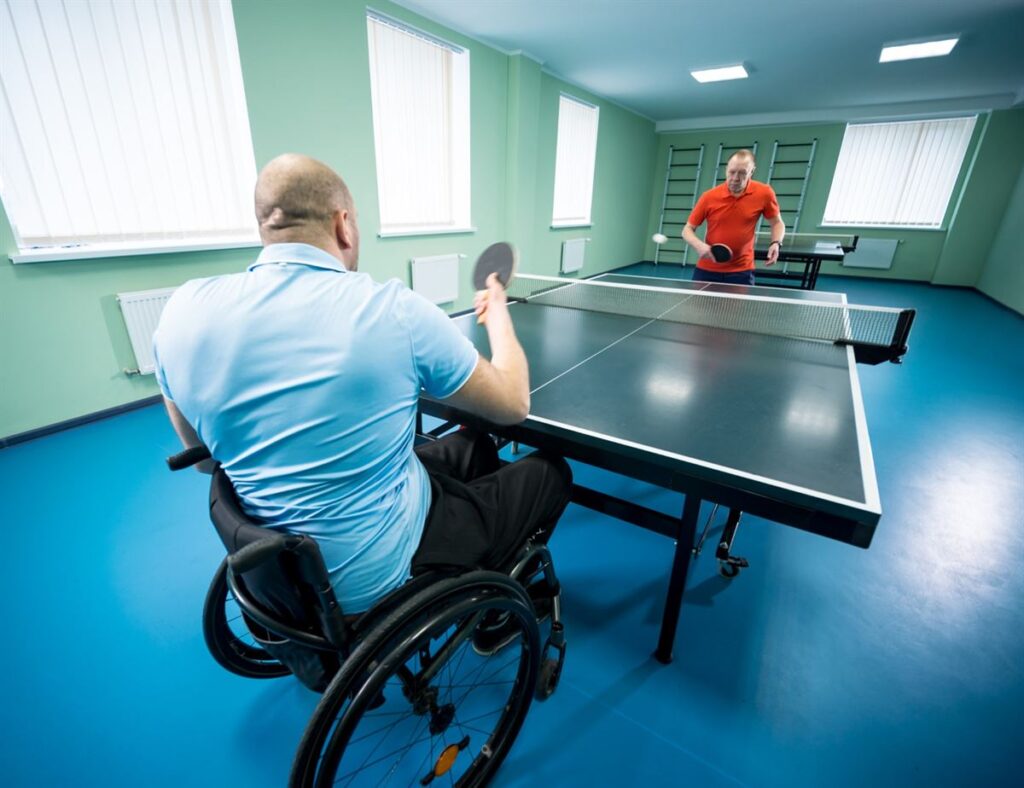
Wheelchair table tennis uses the same table, ball, net and scoring as the standing game. A game still goes to 11, you still serve twice in a row, and the ball still has to bounce once on each side. The official rules add just a handful of adaptations for wheelchair players: a special serving rule, more flexible doubles, and a few rules about how players sit in the chair. This guide explains every one of them, with the official ITTF law numbers, plus tips for adapting the game at home, at school or in a club.
Wheelchair Table Tennis Rules at a Glance
- Everything else is standard: games to 11, win by 2, two serves each, and the usual rules for lets and faults. See our complete ping pong rules.
- The serve is a let if the receiver is in a wheelchair and the ball, after bouncing on the receiver’s side, comes back toward the net, stops on the table, or (in singles) goes out over a sideline (ITTF Law 2.9.1.5).
- In doubles, after the serve and the return, either player of a pair that includes a wheelchair player may hit the ball. They don’t have to alternate (ITTF Law 2.8.3).
- When both players are in wheelchairs, you lose the point if you lift off the seat, touch the table with a hand before hitting the ball, or put a foot or footrest on the floor during play (ITTF Law 2.10.1.14).
- Umpires can relax the serving rules for a player whose physical disability prevents a fully legal serve (ITTF Law 2.6.7).
Who Plays Wheelchair Table Tennis?
Table tennis has been part of the Paralympic Games since the very first Paralympics in Rome in 1960, and it’s one of the most widely played para sports in the world. At the international level, players compete in classes based on how their impairment affects play:
| Class | Who competes |
|---|---|
| 1–5 | Wheelchair players. Class 1 is for players with the most significant impairment, class 5 for the least. |
| 6–10 | Standing players with a physical impairment, again from the most affected (6) to the least (10). |
| 11 | Players with an intellectual impairment. |
In everyday recreational play, of course, nobody needs a classification. Wheelchair users play standing friends, family and clubmates all the time, and the rules below explain exactly how that works.
The Rules That Stay the Same
Most of table tennis doesn’t change at all for wheelchair players:
- The table, net and ball are the standard sizes: a 9 × 5 ft table, 30 in high, with a 6-inch net and a 40 mm ball. See our guide to ping pong table dimensions.
- Scoring is identical: games to 11, win by 2, and matches are the best of 3, 5 or 7 games.
- Serving order is identical: two serves each, then one each from 10-10.
- The basic serve is the same: the ball starts on an open palm, is tossed at least 16 cm (about 6 inches) and is struck as it falls, bouncing once on the server’s side and then on the receiver’s. Read the full ping pong serve rules.
- Rally rules are the same: let the ball bounce once on your side, and don’t volley it.
The Wheelchair Serving Rule
The most important adaptation is about the serve. A very short, spinning serve that dies on the table, or one that kicks sideways off the table, can be physically impossible for a seated player to reach. So the rules turn those serves into lets.
When the receiver is in a wheelchair and the serve is otherwise legal, the serve is a let (replayed with no point) if, after bouncing on the receiver’s side, the ball:
- Comes back toward the net, for example because of heavy backspin;
- Comes to rest on the receiver’s side of the table; or
- In singles, leaves the table over either sideline after bouncing on the receiver’s side.
These three cases come from ITTF Law 2.9.1.5. In practice, it means that serves to a wheelchair player need to travel toward the receiver’s end line. A good serve to a wheelchair player is usually a long, deep serve, which is why wheelchair players spend a lot of time practicing fast, deep serves and returns.
The rule applies whenever the receiver is in a wheelchair, even if the server is standing. If a wheelchair player serves to a standing player, the normal serving rules apply.
Relaxed Serving Requirements
Some players can’t toss the ball from an open palm because of their impairment. The rules allow for this: an umpire may relax the requirements for a correct serve if they’re satisfied that a player’s physical disability prevents them from complying (ITTF Law 2.6.7). In casual games, simply agree before you start what counts as a fair serve.
Wheelchair Doubles Rules
In standing doubles, partners must strictly alternate shots. In wheelchair doubles, that would be extremely hard, because players can’t quickly swap positions. So the rule is different.
- Who can hit the ball: when at least one player of a pair is in a wheelchair, the server serves and the receiver returns as normal, but after that, either player of that pair may make the returns (ITTF Law 2.8.3).
- The center line: a pair that includes a wheelchair player loses the point if any part of the wheelchair, or the foot of a standing partner, crosses an imaginary extension of the table’s center line (ITTF Law 2.10.1.15). In other words, each partner stays on their own half, and the pair covers the table side by side.
- The serve still goes diagonally, from the server’s right half to the receiver’s right half, as in all doubles.
Seating and Position Rules
When both players or pairs are in wheelchairs, three extra rules keep the game fair. You lose the point if you:
- Lose contact with the seat: you must keep at least minimum contact with the seat or cushion, with the back of your thigh, when you strike the ball. You can’t stand up or lift yourself off the chair to reach a shot (ITTF Law 2.10.1.14.1).
- Touch the table with either hand before hitting the ball: you can’t lean on the table to reach a ball (ITTF Law 2.10.1.14.2). The usual rule that your free hand must never touch the playing surface also still applies.
- Put a footrest or foot on the floor during play (ITTF Law 2.10.1.14.3).
These seating rules apply only when both sides are in wheelchairs. In a game between a wheelchair player and a standing player, the standing player obviously isn’t sitting, so the regular rules apply to each player.
Playing at Home, at School or in a Club
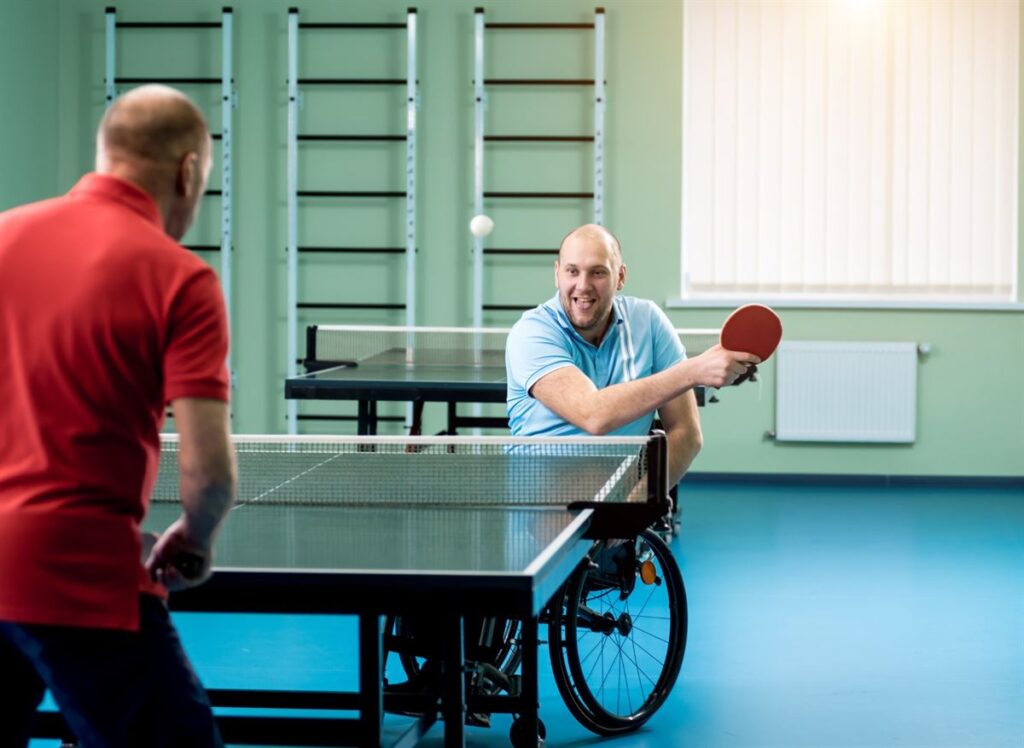
You don’t need special equipment to start. A few practical adjustments make the game easier and more fun:
- Check the leg clearance. A wheelchair user needs to get close to the end of the table. Tables whose legs are set back from the ends work best. If the legs get in the way, try the other end or a different table.
- Give plenty of room. Leave enough space behind and beside the table for the chair to move freely, and keep the floor clear of stray balls. Our guide to table dimensions and room size has the numbers.
- Help with grip. Players with limited grip can attach the paddle to the hand with an elastic strap or tape, or use a paddle with a thicker handle.
- Slow the game down for beginners. Larger, slower training balls and gentle rallies help new players build control before moving to the standard 40 mm ball.
- Use simple rally games. Count how many shots a pair can keep going together, aim at targets on the table, or play “deep serves only” to practice the wheelchair serving rule.
Keep a copy of our free printable ping pong rules sheet next to the table so everyone knows the basics, and use the free ping pong scoreboard to keep track of the score and the serve.
Wheelchair Table Tennis FAQ
Is wheelchair table tennis a Paralympic sport?
Yes. Table tennis has been part of every Paralympic Games since the first Games in Rome in 1960. Wheelchair players compete in classes 1 to 5.
Do wheelchair players use a different table?
No. The table, net and ball are the same standard sizes as in the standing game. Tables with legs set back from the ends make it easier for wheelchair users to get close.
What is the serve rule in wheelchair table tennis?
If the receiver is in a wheelchair, a serve is a let if, after bouncing on the receiver’s side, the ball comes back toward the net, stops on the table, or in singles goes out over a sideline (ITTF Law 2.9.1.5).
Can a wheelchair player play against a standing player?
Yes. The wheelchair serving rule applies whenever the receiver is in a wheelchair. The seating rules apply only when both players are in wheelchairs.
Do partners have to alternate shots in wheelchair doubles?
No. When at least one player of a pair is in a wheelchair, either player of that pair may make the returns after the serve and the return (ITTF Law 2.8.3).
Can a wheelchair player touch the table?
When both players are in wheelchairs, a player loses the point for touching the table with either hand before striking the ball. The free hand may never touch the playing surface during a rally in any form of table tennis.
Last reviewed: October 2026. Rule numbers refer to the Laws of Table Tennis (ITTF Statutes, 2026 edition). International para competitions also follow additional World Para Table Tennis regulations.