
The serve is the most argued-about part of ping pong. Can you serve straight? How high do you have to toss the ball? Is it a let if it clips the net? This guide explains the official ping pong serve rules from the ITTF, step by step, along with the serving order, doubles serves and the most common mistakes that make a serve illegal.
Ping Pong Serve Rules: The Short Version
- Start with the ball resting on your flat, open palm, and keep your hand still.
- Toss the ball nearly straight up, at least 16 cm (about 6 inches), without spinning it.
- Hit the ball as it falls.
- Keep the ball behind your end line and above the level of the table until you hit it.
- Don’t hide the ball from your opponent at any point.
- The ball must bounce once on your side, then once on your opponent’s side.
- In singles, the serve can go anywhere on the opponent’s half. In doubles, it must go diagonally, right half to right half.
- A serve that touches the net and still lands correctly is a let: serve again.
Each player serves two points in a row, and from 10-10 the serve alternates after every point. The rest of this article explains each rule in detail.
How to Serve in Ping Pong, Step by Step

1. The Starting Position: Ball on an Open Palm
A legal serve begins with the ball resting freely on the open palm of your free hand (the hand not holding the paddle). Your hand must be flat and still. You can’t hold the ball in your fingers, cup it, or spin it between your fingertips (ITTF Law 2.6.1).
At this point, your hand and the ball must already be above the level of the playing surface and behind your end line.
2. The Toss: At Least 16 cm, Nearly Vertical, No Spin
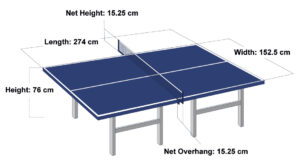
Project the ball upward so that it rises at least 16 cm (about 6.3 inches) after leaving your palm. A good guide is to toss it at least as high as the net is tall, plus a little extra. The toss must be nearly vertical: you can’t throw it forward toward the net or sideways across your body. And you can’t add spin with your hand; all spin must come from the paddle (ITTF Law 2.6.2).
Many recreational players barely toss the ball at all or throw it from their fingertips. Both are illegal under the official rules, although few people enforce this in casual games.
3. Hit the Ball on the Way Down
You must strike the ball as it falls, after it reaches the top of the toss. Hitting it on the way up is a fault. The ball must not touch anything else before you hit it (ITTF Laws 2.6.2–2.6.3).
4. Behind the End Line and Above the Table
From the start of the serve until you hit it, the ball must stay behind your end line (or its imaginary extension if you’re standing off to the side) and above the level of the playing surface. You can’t reach over the table to serve, and you can’t drop the ball below table height and hit it from underneath (ITTF Law 2.6.4).
5. Keep the Ball Visible
Your opponent must be able to see the ball at all times during the serve. You can’t hide it with your body, your free arm, your clothing or, in doubles, your partner. As soon as you toss the ball, you must move your free arm and hand out of the space between the ball and the net (ITTF Laws 2.6.4–2.6.5).
This “no hidden serve” rule was introduced in 2002, because top players were hiding the contact point to disguise their spin.
6. The Bounce Sequence
After you strike it, the ball must:
- Bounce once on your own side of the table first,
- Pass over or around the net,
- Then bounce on the receiver’s side.
If you hit the ball directly over the net without it first bouncing on your side, that’s a fault and you lose the point. Your opponent must let the serve bounce once before returning it (ITTF Law 2.6.3).
Do You Have to Serve Diagonally in Ping Pong?
In singles, no. Under official ITTF rules, a singles serve can land anywhere on your opponent’s half of the table: diagonally, straight down the line or right down the middle. The white center line has no meaning in singles.
In doubles, yes. The serve must bounce first in the server’s right half court and then in the receiver’s right half court, a diagonal path. The center line counts as part of each right half, so a ball that lands on it is good (ITTF Laws 2.6.3 and 2.1.6).
Many casual players use a diagonal-serve house rule for singles. That’s fine, as long as everyone agrees on it before the game starts.
What Happens When the Serve Hits the Net?
If your serve touches the net or net posts and then lands correctly on the receiver’s side, it’s a let. The point is replayed with no score, and you serve again (ITTF Law 2.9.1.1). There’s no limit to the number of lets you can serve in a row. (The old “three lets and you lose the point” rule is a house rule, not an official one.)
If the serve touches the net and doesn’t land on the receiver’s side, you lose the point.
Other situations that result in a let:
- You serve when the receiver isn’t ready, and the receiver doesn’t try to return the ball (ITTF Law 2.9.1.2).
- Play is disturbed by something outside the players’ control, such as a ball rolling onto the court from another table (ITTF Law 2.9.1.3).
What Counts as a Fault?
You lose the point if:
- The serve doesn’t bounce on your side first, or misses the receiver’s side.
- The serve goes into the net and doesn’t come over.
- You toss the ball and miss it completely. Once the toss is made, the ball is in play and you’re committed to the serve (ITTF Laws 2.5 and 2.10.1.1).
- The toss is too low, not vertical enough, or spun with your hand.
- You hit the ball on the way up, from below table height, or in front of your end line.
- You hide the ball from the receiver.
- In doubles, the serve doesn’t go right half to right half.
In official matches, if the umpire is unsure about the legality of a serve, they can warn the server the first time in a match without awarding a point. After that, any serve that isn’t clearly legal is a fault (ITTF Law 2.6.6.1).
Is an Edge Ball on the Serve Good?
Yes. If the serve clips the top edge of the receiver’s side of the table, it’s a good serve, just like during a rally. If it hits the side of the table below the playing surface, it’s a fault.
Who Serves First, and How Long?
Choosing the First Server
Officially, the right to serve first is decided by lot, usually a coin toss. The winner chooses whether to serve or receive first, or which end of the table to start at (ITTF Law 2.13.1). In casual play, many people rally for serve instead.
Two Serves Each
Each player serves two points in a row, then the serve passes to the opponent. This continues until one player wins the game, or until the score reaches 10-10 (ITTF Law 2.13.3).
Serving at Deuce (10-10)
At 10-10, each player serves one point at a time, alternating, until one player leads by two points and wins the game.
Serving in the Next Game
The player who served first in a game receives first in the next game (ITTF Law 2.13.6). The players also change ends after each game. In the last possible game of a match, they also change ends when one player reaches 5 points, but the serving order doesn’t change (ITTF Law 2.13.7).
Before 2001, games went to 21 points and each player served five times in a row. You’ll still see this in some casual games. See our complete guide to the ping pong rules for scoring, rallies and everything else.
Doubles Serving Rules
Doubles adds two extra serving rules:
- Diagonal serves. Every serve goes from the server’s right half court to the receiver’s right half court.
- A rotating order. If pair A and B play pair X and Y, and A serves first to X, the serving order is:
| Serves | Server | Receiver |
|---|---|---|
| 1–2 | A | X |
| 3–4 | X | B |
| 5–6 | B | Y |
| 7–8 | Y | A |
The cycle then repeats (ITTF Laws 2.13.4–2.13.5). After the serve, partners must take turns hitting the ball.
Wheelchair Serving Rules
In para table tennis, there’s an extra rule when the receiver is a wheelchair player. A serve is a let if, after bouncing on the receiver’s side, the ball:
- Comes to rest on the table,
- In singles, leaves the table over either sideline, or
- Bounces back toward the net.
This prevents serves that a seated player can’t physically reach (ITTF Law 2.9.1.5). Umpires can also relax the serving requirements for a player whose physical disability prevents a fully compliant serve (ITTF Law 2.6.7).
Types of Serves to Learn
Once you can serve legally every time, start adding variety. The most common serves are:
- Backspin serve: brush under the ball. The ball floats and tends to pull the return into the net. A short backspin serve is the most useful serve for beginners.
- Topspin serve: brush up the back of the ball. It kicks forward off the table.
- Sidespin serve: brush the side of the ball, often with the popular “pendulum” motion. The ball curves and kicks sideways.
- No-spin (float) serve: a serve that looks spinny but isn’t, so the opponent misreads it.
- Fast long serve: a deep, fast serve to the corner or the opponent’s body, used to surprise.
For more on practicing your serve, see our table tennis tips.
Ping Pong Serve Rules FAQ
Can you serve straight in ping pong?
Yes, in singles. The serve can land anywhere on the opponent’s half of the table. In doubles, it must go diagonally from right half to right half.
How high do you have to toss the ball when serving?
At least 16 cm (about 6 inches), nearly straight up, from a flat open palm.
Does the serve have to bounce on your side in ping pong?
Yes. The ball must bounce once on your side and then once on the receiver’s side. Hitting it directly over the net is a fault.
How many serves do you get in ping pong?
Two in a row, then the serve switches. From 10-10, the serve switches after every point. There’s no second serve: a fault loses the point immediately.
What happens if the serve hits the net?
If it touches the net and lands on the receiver’s side, it’s a let and you serve again. If it doesn’t land on the receiver’s side, you lose the point.
Is it legal to serve with spin?
Yes. You can put any spin on the ball with your paddle. You just can’t spin it with your hand during the toss.
Can you serve underhand in ping pong?
Yes. Ping pong has no rule about serving overhand or underhand. The rules only concern the toss, the contact point and the bounce, so any paddle motion is allowed as long as the ball stays above the table and behind the end line.
What happens if you miss the ball when serving?
If you toss the ball and miss it completely, it’s a fault and your opponent wins the point.
Last reviewed: October 2026. Rule numbers refer to the Laws of Table Tennis (ITTF Statutes, 2026 edition). Local leagues may use small variations, so check with the organizer before you play.