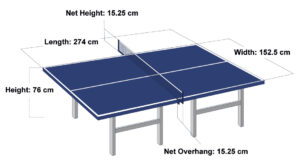

A regulation ping pong table is 9 feet long, 5 feet wide and 30 inches high (2.74 m × 1.525 m × 76 cm). That’s the official size set by the International Table Tennis Federation (ITTF), and it’s the same size you’ll find in clubs, tournaments and most home “full-size” tables.
Below you’ll find every official measurement in feet, inches and centimeters, the sizes of smaller tables, and how much room you actually need to play comfortably at home.
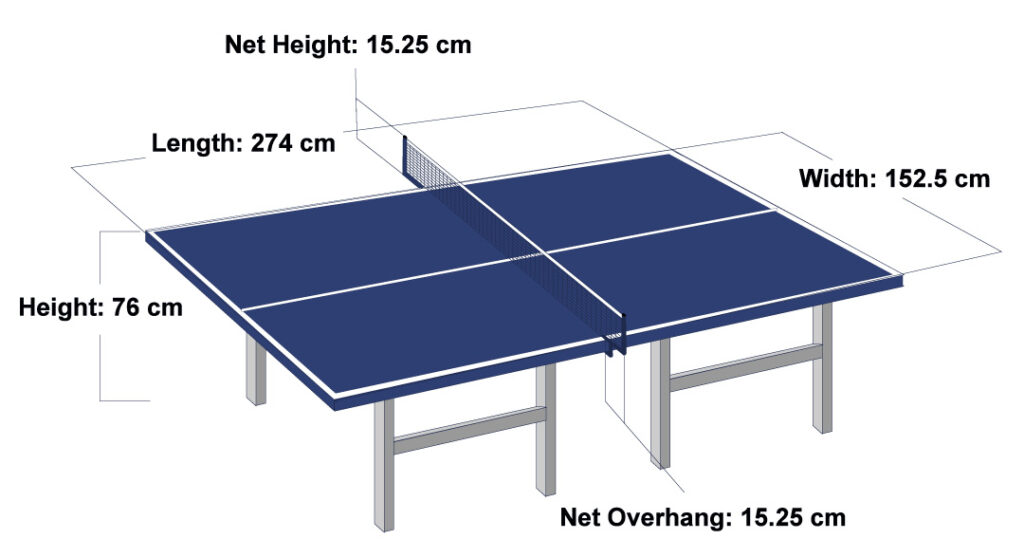
Official Ping Pong Table Dimensions
| Measurement | Feet / inches | Metric |
|---|---|---|
| Length | 9 ft (108 in) | 2.74 m (274 cm) |
| Width | 5 ft (60 in) | 1.525 m (152.5 cm) |
| Height (floor to playing surface) | 2.5 ft (30 in) | 76 cm |
| Each half of the table | 4.5 ft × 5 ft | 1.37 m × 1.525 m |
| Net height | 6 in | 15.25 cm |
| Net length (post to post) | 6 ft (72 in) | 1.83 m |
| White edge lines | about ¾ in wide | 2 cm |
| Center line | about ⅛ in wide | 3 mm |
The imperial numbers are rounded. The exact conversion of 2.74 m is 107.9 inches, and 76 cm is 29.9 inches. Manufacturers round them to 9 ft and 30 in, and nobody will notice the difference.
How Long Is a Ping Pong Table?
A standard ping pong table is 9 feet (2.74 m) long (ITTF Law 2.1.1). The net divides it into two halves, each 4.5 feet (1.37 m) long.
How Wide Is a Ping Pong Table?
A standard table is 5 feet (1.525 m) wide (ITTF Law 2.1.1). A thin white center line runs down the length of the table and splits each half into two equal “half courts,” each 2.5 feet wide. That line only matters for serving in doubles (ITTF Law 2.1.6). In singles, you can ignore it. (See our guide to ping pong rules for how doubles serving works.)
How Tall Is a Ping Pong Table?
The playing surface sits 30 inches (76 cm) above the floor (ITTF Law 2.1.1). That’s roughly the height of a standard dining table. Most full-size tables have fixed legs, but some models include adjustable feet so you can level the table on an uneven floor without changing the playing height.
Ping Pong Net Dimensions
The top of the net must be 6 inches (15.25 cm) above the playing surface along its entire length (ITTF Law 2.2.3). The net posts sit 6 inches outside each sideline (ITTF Law 2.2.2), so the net assembly is 6 feet (1.83 m) long in total, a little wider than the table itself. Over time, nets sag in the middle; if you play often, check the height with a ruler now and then and tighten the cord.
Table Thickness, Surface and Weight
The ITTF rules don’t set a thickness for the tabletop. Instead, they set a performance standard: a regulation ball dropped from 30 cm (about 12 inches) must bounce back about 23 cm (9 inches) anywhere on the table (ITTF Law 2.1.3). In practice, the thickness of the top is the biggest factor in how well a table plays.
| Tabletop thickness | Typical use | What to expect |
|---|---|---|
| 12–15 mm (½ in) | Budget recreational | Uneven, lower bounce; fine for casual family games |
| 16–19 mm (⅝–¾ in) | Mid-range home tables | Decent bounce; a good choice for regular home play |
| 22–25 mm (⅞–1 in) | Club and tournament tables | Consistent, high bounce; required for ITTF-approved tables |
The playing surface must be a dark, uniform color with a matte finish, usually blue or green, so the ball is easy to see (ITTF Law 2.1.4). Outdoor tables use aluminum or composite tops instead of wood, and they usually bounce slightly less than a good indoor table.
A full-size table typically weighs between 100 and 300 pounds (45–135 kg). Thicker tops and heavier frames add weight, so a heavy table is usually a sign of a better bounce. It’s also harder to move, so look for good wheels if you’ll be folding it away.
Folded Ping Pong Table Dimensions
Most home tables fold up for storage. The usual design is “playback” style: one half folds up vertically, so one person can practice against it while the other half stays flat. Fully folded, a typical full-size table takes up about:
- Width: about 5 ft (the width of the table doesn’t change)
- Height: about 5 to 5.5 ft
- Depth: about 2 to 2.5 ft
Folded sizes vary by brand and model, so check the manufacturer’s specs before you buy if you’re fitting a table into a tight garage or storage room.
Smaller Ping Pong Table Sizes
If you don’t have room for a full-size table, smaller tables are available. They’re great for kids and small apartments, but the game plays differently: rallies are shorter and you can’t use full strokes.
| Table type | Typical size | Best for |
|---|---|---|
| Full size (regulation) | 9 ft × 5 ft, 30 in high | Anyone who wants the real game |
| Mid-size (often called ¾ size) | about 6–7 ft × 3–3.5 ft | Small game rooms, younger players |
| Mini / tabletop | about 4–5 ft × 2–2.5 ft | Kids, apartments, casual fun |
| Conversion top | 9 ft × 5 ft, placed on a pool or dining table | Adding ping pong without a second table |
Smaller sizes aren’t standardized, so “mid-size” means different things from different brands. Always check the actual dimensions in the listing.
A quick note on beer pong: a beer pong table is a different thing entirely. It’s long and narrow, typically 8 ft × 2 ft, and doesn’t use a net.
How Much Space Do You Need for a Ping Pong Table?
The table itself is only part of the picture. You need open space around it to move, swing and chase down balls. Here’s a practical guide:
| Level of play | Recommended room size | Space around the table |
|---|---|---|
| Minimum (casual play) | 19 ft × 11 ft (5.8 m × 3.4 m) | 5 ft behind each end, 3 ft on each side |
| Comfortable (regular home play) | 23 ft × 13 ft (7 m × 4 m) | 7 ft behind each end, 4 ft on each side |
| Competition (ITTF minimum) | 46 ft × 23 ft (14 m × 7 m) | Plus a ceiling at least 16 ft (5 m) high |
A few tips for fitting a table into your home:
- Space behind the ends matters most. Players move back and forth far more than side to side. If your room is tight, prioritize length.
- Check the ceiling. Around 8 feet is enough for casual play, but low beams or light fixtures will get hit by high lobs.
- Measure your doorways. A folded table is about 5 feet wide, so make sure you can actually get it into the room.
- Mind the floor. A slippery tile or polished concrete floor is easy to fall on. A rubber mat or rug around the table helps.
- Lighting: bright, even light from above works best. Avoid playing with a window directly behind one player.
Ping Pong Ball and Paddle Sizes
For completeness, here are the official sizes of the rest of the equipment:
- Ball: 40 mm (about 1.57 in) in diameter, weighing 2.7 g. Official balls are white or orange with a matte finish (ITTF Laws 2.3.1–2.3.3).
- Paddle: there is no official size or weight limit (ITTF Law 2.4.1). Most paddles measure about 6 inches wide and 10 inches long, including the handle.
Ready to equip your new space? Read our guide on how to choose a table tennis racket, and learn how to keep your paddle clean.
Ping Pong Table Dimensions FAQ
What is the standard size of a ping pong table?
A standard (regulation) ping pong table is 9 feet long, 5 feet wide and 30 inches high, or 2.74 m × 1.525 m × 76 cm.
Are all ping pong tables the same size?
All full-size and tournament tables are the same size. Mid-size, mini and tabletop versions are smaller, and their sizes vary by brand.
How big is a ping pong table in inches?
A regulation table measures 108 inches long, 60 inches wide and 30 inches high. The net is 6 inches tall.
How much room do you need for a ping pong table?
For casual play, plan on a space of at least 19 × 11 feet. For a comfortable game with room to move, 23 × 13 feet is better.
How tall is a ping pong net?
The top of a regulation net is 6 inches (15.25 cm) above the playing surface.
Is a ping pong table the same size as a pool table?
No. A ping pong table is 9 × 5 feet, while a standard 8-foot pool table has a playing area of about 7.3 × 3.7 feet. That’s why ping pong conversion tops hang over the edges of a pool table.
How much does a ping pong table weigh?
Most full-size tables weigh between 100 and 300 pounds, depending on the thickness of the top and the frame.
Last reviewed: October 2026. Official measurements refer to the Laws of Table Tennis (ITTF Statutes, 2026 edition), Laws 2.1–2.4. Sizes for smaller tables, folded tables and table weights are typical ranges and vary by manufacturer.