
Doubles is where most ping pong arguments start. Who serves next? Which partner receives? Do you have to serve diagonally? The good news is that doubles uses all the normal rules of table tennis, plus just three extra ones: diagonal serves, alternating hits and a rotating serving order. This guide explains each of them with the official ITTF law numbers, plus the tactics that make doubles easier to play.
Ping Pong Doubles Rules at a Glance
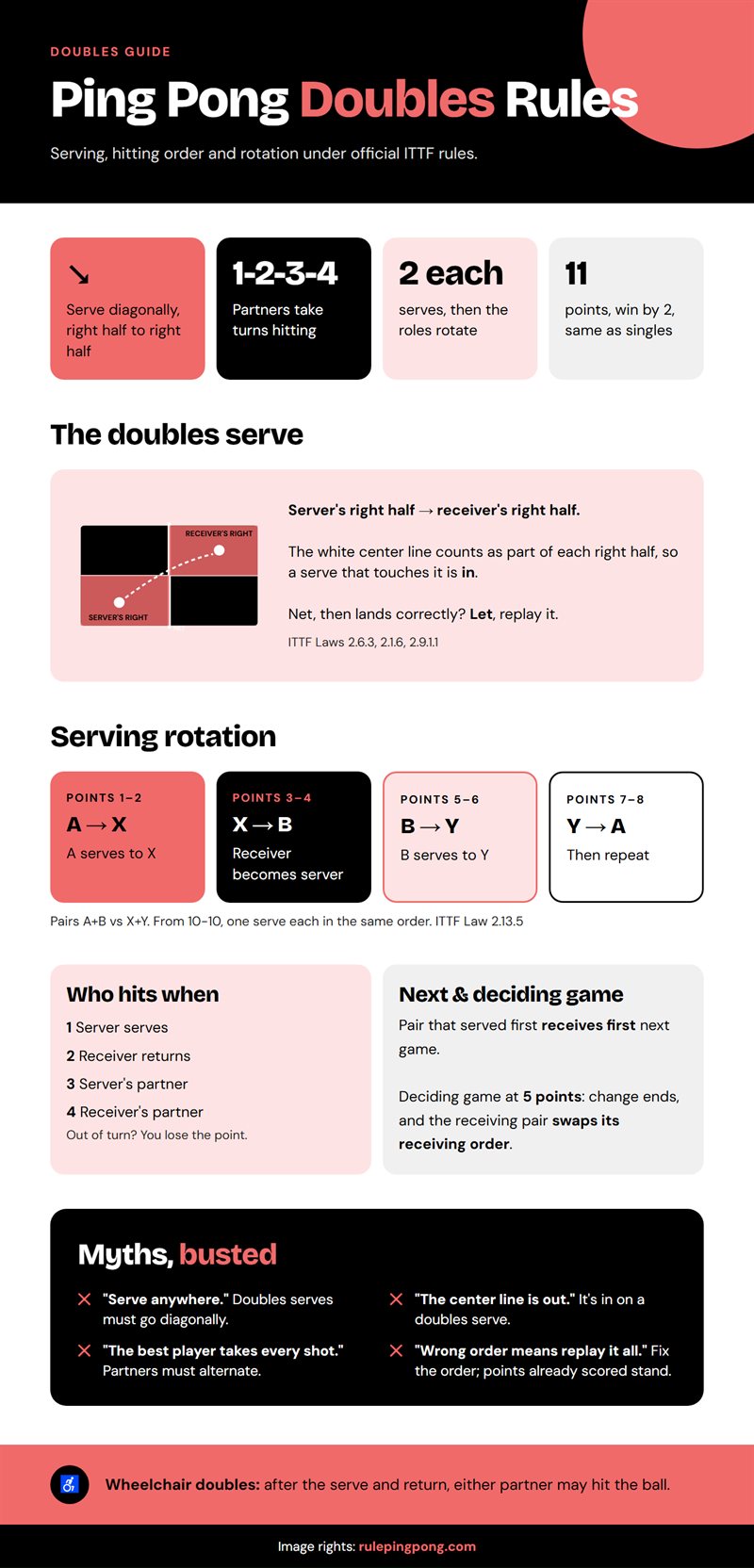
- Serve diagonally: every serve goes from the server’s right half court to the receiver’s right half court (ITTF Law 2.6.3). The center line counts as part of each right half (ITTF Law 2.1.6).
- Take turns hitting: server, receiver, server’s partner, receiver’s partner, and so on. Hitting out of turn loses the point (ITTF Laws 2.8.2 and 2.10.1.12).
- Two serves each, then rotate: at each change of service, the previous receiver becomes the server and the previous server’s partner becomes the receiver (ITTF Law 2.13.5).
- Scoring is the same as singles: games to 11, win by 2, one serve each from 10-10 (ITTF Laws 2.11.1 and 2.13.3).
- Deciding game: the receiving pair changes its receiving order when the first pair reaches 5 points, and both pairs change ends (ITTF Laws 2.13.6 and 2.13.7).
The Doubles Serve
In singles, a serve can land anywhere on the opponent’s half. In doubles, it can’t. The serve must bounce first in the server’s right half court and then in the receiver’s right half court, so it always travels diagonally across the table (ITTF Law 2.6.3).
A few details settle most arguments:
- “Right” means right from each player’s own point of view. Standing at your end, your right half court is on your right; the receiver’s right half court is on their right, which is diagonally opposite.
- The white center line is in. It counts as part of each right half court, so a serve that touches it is good (ITTF Law 2.1.6).
- A serve that bounces in the wrong half is a fault, and the receiving pair wins the point.
- A serve that clips the net and then lands correctly is a let, and is replayed (ITTF Law 2.9.1.1).
Everything else about the serve is the same as in singles: the open-palm toss of at least 16 cm, hitting the ball as it falls, and keeping it visible. See our full ping pong serve rules.
The Order of Play: Who Hits When
After the serve, partners must take turns. The order is fixed (ITTF Law 2.8.2):
- The server serves.
- The receiver returns.
- The server’s partner hits.
- The receiver’s partner hits.
- Then the server again, and so on.
If a player hits the ball out of turn, their pair loses the point (ITTF Law 2.10.1.12). That’s why doubles players constantly move in and out of position: after you hit, you step out of the way so your partner can reach the next ball.
The Serving Order in Doubles
Each player serves two points in a row, just as in singles, but the roles rotate around all four players. At each change of service, the previous receiver becomes the server, and the partner of the previous server becomes the receiver (ITTF Law 2.13.5).
If pair A and B play pair X and Y, and A serves first to X, the order is:
| Points | Server | Receiver |
|---|---|---|
| 1–2 | A | X |
| 3–4 | X | B |
| 5–6 | B | Y |
| 7–8 | Y | A |
| 9–10 | A | X |
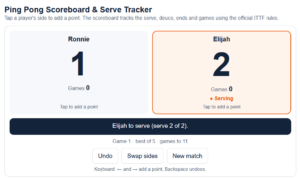
The cycle repeats every eight points. From 10-10, each player serves one point at a time, in the same order (ITTF Law 2.13.3). Our free ping pong scoreboard tracks this rotation for you, including who serves to whom.
Who Serves and Receives First?
At the start of the match, the right to serve or receive first is decided by lot, such as a coin toss (ITTF Law 2.13.1). Then:
- The serving pair chooses which partner serves first.
- In the first game, the receiving pair chooses which partner receives first (ITTF Law 2.13.4).
The Next Game
The pair that served first in a game receives first in the next game (ITTF Law 2.13.6). The pair now serving chooses which partner serves first, and the first receiver is then fixed: it’s the player who served to that server in the previous game (ITTF Law 2.13.4). In the example above, if X serves first in game 2, X serves to A, because A served to X in game 1.
The Deciding Game
In the last possible game of a match (for example, game 5 of a best-of-five), two things happen when the first pair reaches 5 points:
- The pairs change ends (ITTF Law 2.13.7).
- The pair due to receive next changes its receiving order (ITTF Law 2.13.6). This stops the same player from receiving the same opponent’s serve for the whole deciding game.
What Happens If You Get the Order Wrong?
Mistakes happen, especially in casual games. Under the official rules, if a player serves or receives out of turn, play is stopped as soon as the error is noticed and resumes with the correct server and receiver at the score already reached. All points scored before the mistake was discovered still count (ITTF Laws 2.14.1 and 2.14.3).
Wheelchair Doubles
When at least one player of a pair is in a wheelchair, the strict alternation is relaxed: after the serve and the return, either player of that pair may make the returns (ITTF Law 2.8.3). In return, a pair that includes a wheelchair player loses the point if any part of the wheelchair, or a standing partner’s foot, crosses an imaginary extension of the center line (ITTF Law 2.10.1.15).
Doubles Tactics That Help
The rules force you to share the table with a partner who is constantly in your way, so movement and communication matter more than in singles.
- Move in and out, not side to side. Many pairs use an “in and out” pattern: after hitting, step back and to the side to clear space, then come back in for your next shot.
- Agree on serves in advance. Many pairs signal the planned serve to the partner with a hidden hand gesture under the table, so the partner knows what return to expect.
- Play to the gaps. Aim for the player who has to move furthest to reach the ball, or at the point where the opponents might collide.
- Mix right- and left-handers if you can. A right-handed and left-handed pair get in each other’s way less, because their forehands are on opposite sides.
- Keep the ball low and short on serves. The diagonal serve rule makes long serves easier to predict, so short serves are especially useful in doubles.
For singles and general rules, see our complete ping pong rules or keep the printable rules sheet by the table.
Ping Pong Doubles Rules FAQ
Do you have to serve diagonally in doubles?
Yes. Every doubles serve must bounce in the server’s right half court and then in the receiver’s right half court (ITTF Law 2.6.3). In singles, the serve can go anywhere.
Do you have to alternate hits in doubles ping pong?
Yes. Partners take turns: server, receiver, server’s partner, receiver’s partner. Hitting out of turn loses the point (ITTF Laws 2.8.2 and 2.10.1.12). The exception is wheelchair doubles, where either player of a pair with a wheelchair player may return after the serve and return.
How does the serve rotate in doubles?
Each player serves twice. At each change, the previous receiver becomes the server and the previous server’s partner becomes the receiver: A to X, X to B, B to Y, Y to A, then repeat (ITTF Law 2.13.5).
Is the center line in or out on a doubles serve?
In. The center line counts as part of each right half court (ITTF Law 2.1.6).
What happens at 5 points in the last game of a doubles match?
The pairs change ends, and the pair due to receive next changes its receiving order (ITTF Laws 2.13.6 and 2.13.7).
Is doubles scoring different from singles?
No. Games go to 11 and must be won by 2, and matches are the best of an odd number of games.
Last reviewed: November 2026. Rule numbers refer to the Laws of Table Tennis (ITTF Statutes, 2026 edition).