
Table tennis scoring is simple once you know it: games are played to 11 points, you must win by 2, and a match is the best of 3, 5 or 7 games. A point is scored on every rally, no matter who served. Below, we explain how points, games and matches work, how serving fits into the score, and the scoring rules that catch casual players out.
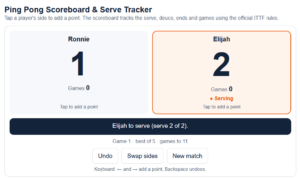
Need an online scoreboard? Click here to use our free one!
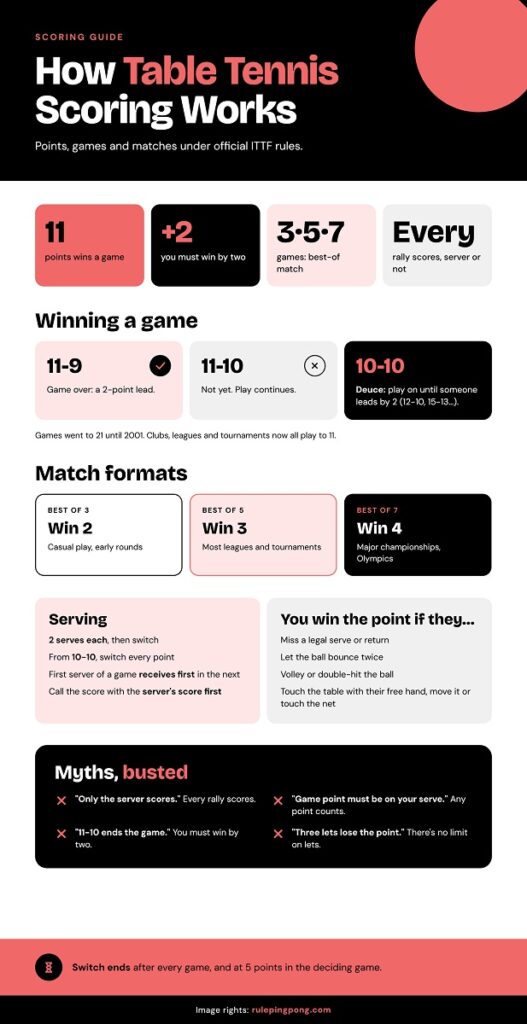
Table Tennis Scoring at a Glance
| Element | Official rule |
|---|---|
| Points to win a game | 11 |
| Winning margin | At least 2 points (play continues past 10-10 until someone leads by 2) |
| Match length | Best of 3, 5 or 7 games |
| Who scores? | Whoever wins the rally, server or receiver |
| Serves per player | 2 in a row; 1 each from 10-10 |
| Calling the score | Server’s score first |
How Many Points Is a Game of Ping Pong?
A game goes to 11 points. The first player to reach 11 wins the game, as long as they lead by at least 2 points (ITTF Law 2.11.1). That means:
- 11-9 wins the game.
- 11-10 does not. Play continues.
- At 10-10, called “deuce,” the game goes on until one player leads by two, for example 12-10 or 15-13.
There’s no upper limit, so a game can in theory go on indefinitely. In practice, long deuce battles past 15-15 are rare.
Is It 11 or 21 Points?
The official game has been played to 11 since 2001. Before that, games went to 21 points and each player served five times in a row. Many casual players still play to 21, which is fine as a house rule, but every club, league and tournament uses 11. Read more about the rule changes in our history of table tennis.
How Many Sets Are in Table Tennis?
In table tennis, what other sports call “sets” are officially called games. A match is always the best of an odd number of games (ITTF Law 2.12.1):
| Format | Games needed to win | Where it’s used |
|---|---|---|
| Best of 3 | 2 | Casual play, some early tournament rounds |
| Best of 5 | 3 | Most leagues and tournaments; individual matches in team events |
| Best of 7 | 4 | Major championships, including Olympic singles |
So a best-of-five match could end 3-0, 3-1 or 3-2 in games.
How Scoring Works Point by Point
Every rally that isn’t a let ends with a point for one player. Under ITTF Law 2.10, you win a point when your opponent:
- Fails to make a legal serve
- Fails to return the ball onto your side of the table
- Lets the ball bounce twice on their side
- Hits the ball before it bounces on their side (a volley)
- Deliberately hits the ball twice in a row
- Touches the table with their free hand, moves the table or touches the net during a rally
A let, such as a serve that clips the net and lands in, is replayed and no point is scored (ITTF Law 2.9). For the full list of rally rules, see our complete guide to the ping pong rules.
How Serving Fits Into the Score
- Each player serves two points in a row, then the serve switches (ITTF Law 2.13.3).
- From 10-10, the serve switches after every point.
- The player who served first in a game receives first in the next game (ITTF Law 2.13.6).
A quick way to check whose serve it is: add both players’ scores together and divide by two, ignoring any remainder. If the result is even (0, 2, 4…), the player who served first in the game is serving; if it’s odd, the other player is. For example, at 3-2 the total is 5, half of that is 2 (even), so the first server has the serve. This works until 10-10, after which the serve simply alternates every point.
For everything about legal serves, read our guide to the ping pong serve rules.
How to Call the Score
The score is called before each serve, with the server’s score first. So if you’re serving and you have 7 points while your opponent has 5, the score is “7-5.” If your opponent serves the next point at that score, they’d call it “5-7.”
At the end of a game, the score in games is also called, for example “two games to one.”
Changing Ends
Players switch ends of the table after each game. In the deciding game of a match (game 5 of a best-of-5, for example), they also switch ends as soon as one player reaches 5 points (ITTF Law 2.13.7).
Doubles Scoring
Doubles is scored exactly like singles: games to 11, win by 2, matches the best of 3, 5 or 7 games. The differences are in the serving and hitting order. Partners must alternate hits, every serve goes diagonally from the right half court, and the serving order rotates between all four players.
Other Scoring Rules
- Time-outs: each player or pair may take one time-out of up to 1 minute per match.
- Breaks: up to 1 minute between games.
- The expedite rule: if a game is still unfinished after 10 minutes of play, the expedite system starts, unless at least 18 points have already been scored in that game. Once introduced, it stays in place for the rest of the match (ITTF Law 2.15). Players alternate serves every point, and if the receiver makes 13 good returns in a rally, the receiver wins the point.
- Penalty points: in official matches, umpires can award penalty points for repeated misconduct.
Common Scoring Myths
- “You can only score on your own serve.” False. That was the old system in sports like volleyball and badminton. In table tennis, every rally scores.
- “You have to win the last point on your serve.” False. Game point is the same as any other point.
- “A game ends at 11-10.” False. You must win by two.
- “Three lets lose the point.” False. There’s no limit on lets.
Some casual players also have an etiquette tradition of giving away a point instead of winning a game 11-0. It’s a courtesy, not a rule, and many competitive players don’t follow it.
Table Tennis Scoring FAQ
How many points do you need to win a ping pong game?
11 points, with a lead of at least 2. If the score reaches 10-10, play continues until one player is 2 points ahead.
How many sets are in a table tennis match?
Table tennis calls them games. A match is the best of 3, 5 or 7 games, with best of 5 the most common format.
Is ping pong played to 11 or 21?
Officially, 11. The ITTF switched from 21 to 11 points in 2001, though some casual players still play to 21.
How do you keep score in ping pong?
Call the score before each serve, server’s score first. Each player serves twice in a row, and from 10-10 the serve alternates after every point.
What is deuce in table tennis?
Deuce is a 10-10 score. From deuce, each player serves one point at a time, and the game continues until one player leads by 2 points.
Can you win a ping pong game 11-0?
Yes. Under the official rules, an 11-0 game is perfectly legal. Giving away a point at 10-0 is only an informal courtesy some casual players follow.
Last reviewed: October 2026. Rule numbers refer to the Laws of Table Tennis (ITTF Statutes, 2026 edition).